


Course: Harness Engineering
Mentor: Denys Vasyliev, Principal Site Reliability Engineer / UK Global Talent Visa Holder, 17+ years in the industry.

All tickets for this course are already sold out. But we are already planning the next iteration! Leave your details on the Waiting list and we will contact you as soon as the dates for the repeat course are available:
Continuing the topic series of AI Reliability Engineering, we invite you to iteration 3.0 of Harness Engineering!
This time we focus on instrumenting the model: memory, Skills, tools, protocols and external interfaces like Conversational AI. In terms of Agent = Model + Harness, we leave the model as a given and deal with everything that turns it into a working agent, that is, the harness itself.
What is Harness Engineering
The term "Harness" (equipment) is an infrastructural layer that turns a model into a full-fledged agent. The model plans the steps and initiates the tool calls, but the execution of tasks, the preservation of state between sessions, and the integration with external systems lie outside the boundaries of its architecture. Harness closes this loop by providing action implementation, context support, and interaction that makes the agent's work predictable and manageable.
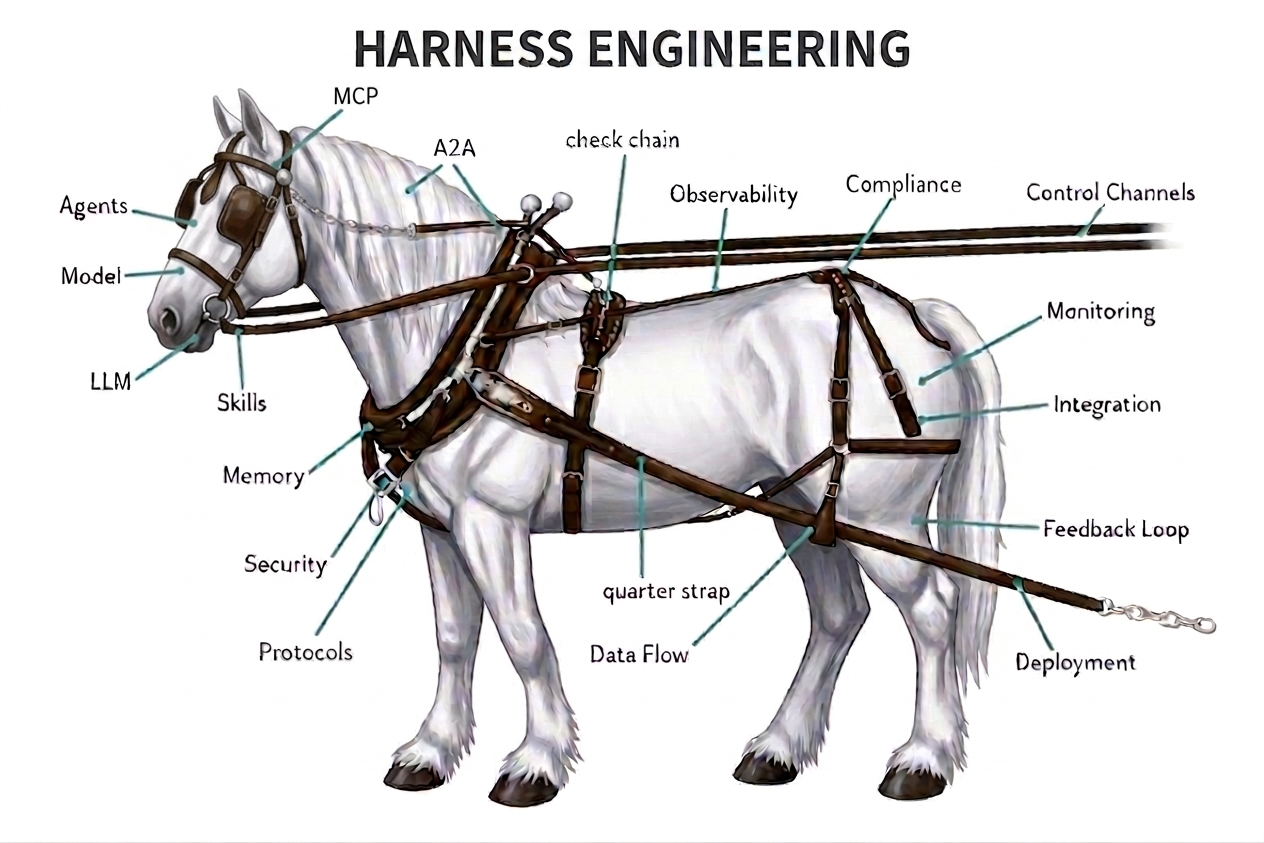
Harness Engineering is the discipline of designing this harness.
We divide Harness into four components:
- Memory: the state of the agent outside of a single run, i.e. working, episodic, and long-term memory.
- Skill: what the agent knows, i.e. skills, tools and frameworks.
- Protocol: how the agent interacts with the world: MCP, A2A, reconcile cycles, governance.
- Interfaces: how a person or another system works with the agent, i.e. coding agents, sub-agents, audio/video Conversational AI.
Format:
This is an intensive practical course in three sprints. The bulk of the work falls on the time between live sessions. It is worth preparing for the course - it will not be easy: we expect you to come with a working base and be ready to invest.
- Joint work: in teams and in pairs
- Mode: online and offline - just like a real project
- Activities: lectures, meetings, practical and homework
Duration: three weeks of online classes on Mondays, Wednesdays and Fridays.
Dates: classes start on Monday, September 7
Platform: Zoom. You will receive a link to the stream before the course begins, and it will also be available on this landing page. In addition, all materials and lecture recordings will be available on the educational platform.
-
Interaction:
The number of participants is limited
Language of the event: Ukrainian
Language of the presentation: Ukrainian and English
*In order to perform practical tasks, it is recommended to have basic knowledge of Linux and any programming language.
**We work with Github, so it is recommended to have a Github account.
Who will be interested?
- Developers
- QA engineers
- System administrators and switchers
- DevOps/SRE approaches
Program
Sprint 1. AI Enablement and Infrastructure
The infrastructure that harness runs on: gateways, AI Inventory, sandboxes.
- AI-adoption challenges in teams
- story-tokens: how to calculate the value of vibecoding
- culture vs. wildcoding
- AgentGateways
- AI Inventory
- GitlessOps
- Sandboxes
- AI Frameworks
Sprint 2. Agentic AI
Active harness, skill, and protocol components: what an agent can do and how it interacts.
- SDLC / PDLC
- AI frameworks
- MCP / A2A protocols
- declarative and custom agents
- Skills
- Tools
- Governance
- Evals and Observability
Sprint 3. Memory
Memory and Interfaces: agent persistence and ways to interact with it.
- dynamic memory according to CoALA
- Long term memory RAG
- GraphRAG
- FractalRAG
- Embeddings / MRL and multimodal RAG
- Interfaces for coding agents and sub-agents
- Audio and Video Conversational AI

Mentor: Denys Vasyliev, Principal Site Reliability Engineer / UK Global Talent Visa Holder
— 17+ years in the industry: from engineer to CTO
— Certified Kubernetes Administrator
— Speaker: Fwdays, DevOpsdays, DevOps-DEX London, SRE Day, Platform Engineering Con
— Author of Kubernetes DIY course
— Author and host of Telegram and YouTube channel "Incorrect DevOps"