


Crash Course: Agentic Engineering
Mentor - Vyacheslav Koldovskyy, Founder of Dev AI Consulting

All tickets for this course are already sold out. But we are already planning the next iteration! Leave your details on the Waiting list and we will contact you as soon as the dates for the repeat course are available:
Are you hesitating about what exactly should be entrusted to agents and what should be controlled by yourself? Trust too little — you pay for AI, and most of the work, as before, is done manually. Trust too much — you will get code that will make you blush in a review.
We invite you to master the six levels of trust in Agentic Engineering in a course from Vyacheslav Koldovsky, founder of Dev AI Consulting!
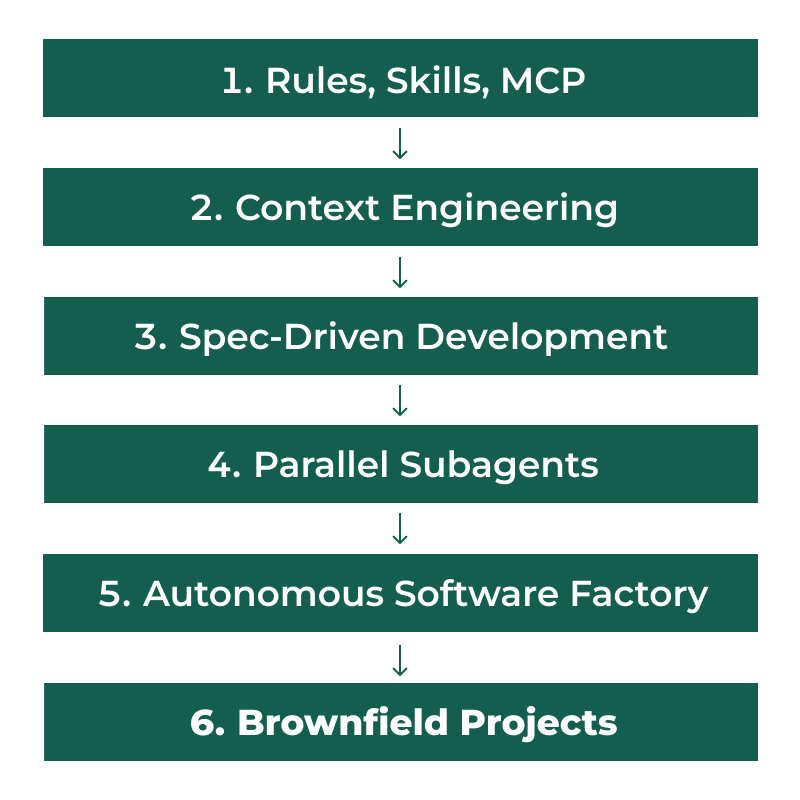
You will gradually go from the first assistant agent, where every action is controlled by a person, to the project factory — a system of autonomous agents that conducts its own work under the supervision of guardrails.
Live-coding awaits you at each lesson: alternately in Claude Code, Cursor, and ChatGPT Codex, without pre-prepared videos.
After the course, you will get:
- - Your own project factory: a properly configured repository and harness around it, built from scratch before your eyes
- - The same approach, tested on code you didn’t write — on a brownfield repository
- - Full observability: you always see what the agent did, why exactly, and how much it cost
- - Practice Spec-Driven Development (SDD) and delegation at all six trust levels — in three different tools
- - Capstone project with a certificate and autonomy log — an artifact you can show the team
- - Cost management: model routing and token budgets so that autonomy doesn’t mean uncontrolled accounts
This course will give you a system for making conscious and safe decisions at every level!
Format:
Platform: 6 online sessions on Tuesdays and Thursdays in ZOOM. You will receive a link to the stream before the course begins, and it will also be available on this landing page. In addition, all materials and lecture recordings will be available on the educational platform.
Dates: September 8-24: 18:30-21:00
Duration of each lesson: ~2.5 hours.
Preparation: Before the start of the course, participants will receive instructions for preparing the environment, tools and a basic set of services for work.
Practical task: To consolidate the material and receive a certificate, participants must create a project in accordance with the requirements of the course program, which will be checked by the mentor (deadline: one week after the last session).
Language of the event: Ukrainian
Language of the presentation: Ukrainian with English terms
For whom this course will be useful:
- - Developers and team leads who want to move from one-off prompts and constant supervision to delegation that delivers evidence and observability, not just promises.
- - Architects and engineering managers who want to build a harness and quality gates for their team—not a personal habit, but a system that can be passed on to others.
- - Technical founders and product managers who want to understand exactly where they can trust an agent without supervision, and where that trust will come at a high cost.
Program
- The first five sessions build a project factory on new code—from the first assistant agent to a harness of autonomous agents. The sixth session transfers everything to brownfield—code you didn’t write. Each session consists of a live demonstration in front of the group, rotating between Claude Code, Cursor, and ChatGPT Codex, so that the focus remains on the discipline itself rather than the interface of a specific tool. No session relies on a pre-recorded video instead of live work.
Day 1: Quick Start: Agent, Rules, Skills, and MCP
- First Contact: The agent makes a suggestion, you decide—and learn to confidently spot when it’s wrong.
- Live demo: From an empty folder to a connected, properly configured repository: pure Next.js, AGENTS.md, and Rules as static context, a real skill, and an MCP connector for up-to-date documentation—everything is built right before the group’s eyes, with observability (a log of every agent action) from the very first commit.
- A repository configured so that the agent is useful from the very first hour
- The difference between “the agent suggested” and “the agent did”—and when each is needed
Day 2: Context Engineering: Static and Dynamic Context
- An agent is only as smart as the quality of the context you’ve prepared for it—and this is where most people fall short.
- Live demo: We build context as an engineering artifact: static (AGENTS.md, Rules—what the agent always knows) versus dynamic (Skills, MCP—what is loaded as needed), plus the first subagent with its own isolated context for a narrow subtask. Then a single real-world requirement is delegated from start to finish; the currency of trust is tests, types, lint, screenshots, and structured output with a clear schema—not a person monitoring the process. And the first guardrails: what the agent is prohibited from touching.
- Static versus dynamic context: what the agent always knows, and what it loads as needed
- How to formulate a task so that the agent can prove it has completed exactly that task
Day 3: Spec-Driven Development
- From “do this task” to “reach this goal”—a fundamentally different type of delegation.
- Live demo: The requirement becomes proof according to the principles of Spec-Driven Development (SDD): first, a specification with a measurable goal (a strict TypeScript build without any explicit `any`, time to interactivity under 1 second)—not a fixed list of tasks. The agent iterates unsupervised within the agentic loop (plan → action → test → verification), with a predefined budget of iterations and tokens to prevent the cycle from spiraling out of control.
- Specification for the code: goal, constraints, measurable readiness criteria—instead of the vague “improve this”
- SDD cycle: propose → apply → archive and deterministic quality gates
Day 4: Workflow of Parallel Subagents
- When a single agent is no longer enough—and how to build a workflow that coordinates multiple subagents without losing control.
- Live demo: The dependency map between parts of the work—a directed acyclic graph (DAG)—shows what can be done in parallel and what must be done sequentially, forming a defined workflow. The orchestrator agent distributes independent tasks among several subagents, each in its own isolated sandbox (parallel worktrees)—a classic orchestrator-worker pattern. Deliberately induced false parallelism—two subagents collide over the same file—and a fix through proper workflow decomposition, live. Also featured here is cost management: model routing (a low-cost model for the mechanical part, a high-performance one for verification) and a token budget for each subagent.
- Orchestrator-worker pattern: one agent distributes tasks, several subagents execute them
- The difference between improvisation in a chat and a documented, reproducible workflow
Day 5: Harnessing Autonomous Agents: The Project Factory
- This is where “using an agent” ends and “managing a factory that runs while you sleep” begins.
- Live demo: The subagents from Lesson 4 and the verifier agent are combined into a single, cohesive, documented workflow: the orchestrator launches the subagents, passes the result to the verifier agent on another model, and the entire chain of deterministic guardrails triggers without human intervention until an exception occurs. Full observability at every step—traceability, telemetry, eval reports, and cost: how many tokens each change cost. Testing—in the style of a red team (deliberately looking for what’s broken)—structurally cannot simply accept the status quo. A circuit breaker stops the cycle upon a repeated failure and escalates to a human. Separately—15–20 minutes on risk, the blast radius of a change, and rapid rollback.
- A chain of guardrails with full observability that won’t let unconfirmed work through
- The human role, narrowed down to “only in exceptional cases”—and why this is actually a stronger solution
Day 6: Agentic Engineering for Brownfield Projects
- Everything you’ve just learned—put to the test on more realistic and complex material: code that wasn’t written by your team and may no longer be actively maintained by anyone.
- Live demo: A single end-to-end scenario on a prepared brownfield repository: quick context recovery, a delegated task with scope and proofs, and the same chain of guardrails—now in a sandbox branch with caution regarding the blast radius of someone else’s code and instant rollback if needed. We wrap up with an honest discussion about what’s most challenging when working with someone else’s code and why.
- Course conclusion: Analysis of the capstone project, including the autonomy log, using a real-world example. What remains human at any level of autonomy: whether there is enough evidence to release a change; the final decision of “yes, no, or redo”; the ability to explain to the team exactly what has changed and why it’s safe. And why explaining decisions—why, not just what—becomes a more valuable asset when the agent doesn’t remember the previous session.
- Quickly regaining context in code you didn’t write
- The same process, applied with caution to someone else’s blast radius
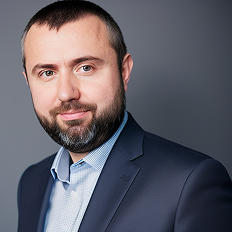
Mentor: Viacheslav Koldovskyi
— Founder Dev AI Consulting
— 20+ years in IT, certified Google Cloud Professional Cloud Architect, nVidia Generative AI LLMs
— Ph.D / Candidate of Economic Sciences, Associate Professor, Head of the Gen AI Center at IT STEP University
— Founder of YouTube and Telegram channels Programming Mentor
— Active speaker: speaking at iForum, DOU Day, etc.
— Leader of the AI community at DOU, author of publications
— Has implemented projects with Gen AI and AI-generated code, which successfully working in production
— Advises companies on transforming SDLC processes using AI